The short answer
- Official MOT rule: A brake lining or pad worn down to the wear indicator fails; worn below 1.5mm it fails as dangerous. A lit pad-wear warning lamp is not a failure on its own.1
- Category: Major at the wear indicator, Dangerous below 1.5mm. Oil or grease on a pad is Major.1
- Can you drive? Worn to the indicator: you may drive it away while the old certificate is in date, provided it is roadworthy. Under 1.5mm: no, it stays until repaired.3
- Typical cost: Front pads: ClickMechanic averages £99, Bumper says £120 to £140 for an axle. Front and rear together: £230 to £300 from Bumper.45
What does the MOT manual say about brake pads?
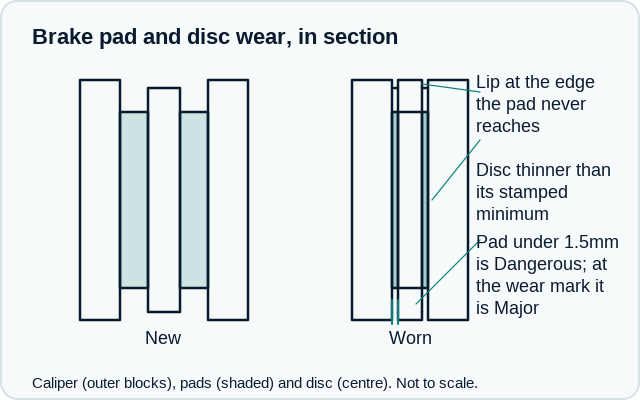
Section 1.1.13 of the DVSA inspection manual is short and specific. The tester rejects a pad in four situations:1
- "Brake lining or pad worn down to wear indicator": Major.
- "Brake lining or pad worn below 1.5mm": Dangerous.
- "Brake lining or pad contaminated with oil, grease etc.": Major.
- "Brake lining or pad missing or incorrectly mounted": Dangerous.
The manual explains that some pads carry a metal tab that squeals against the disc when the pad is nearly gone, while others have a slot that disappears as the pad wears. It adds a line that surprises many drivers: "An illuminated brake wear indicator is not a reason for failure."1 So a dashboard pad warning will not fail the test by itself, but the tester can still fail the pads if they can see they have reached the indicator.
An advisory such as "brake pads wearing thin" means the tester saw wear that had not yet reached the indicator. The manual calls this best practice: telling you about items "near to, but which have not yet reached the point of test failure".2
Why do brake pads wear out?
Pads are a consumable. Every time you brake, the caliper squeezes friction material against the disc and a thin layer is lost as heat and dust. How fast that happens depends on the car's weight, how much of your driving is stop-start, how hard you brake and the pad compound fitted.
Front pads usually go first because weight shifts forward under braking and the front axle does most of the work. That is why prices are quoted separately for front and rear. Uneven wear, where one pad on a wheel is much thinner than its partner, often points to a sticking caliper slide or piston rather than driving style; that is something for the garage to check, not something to guess at from the outside.
Contamination is the other route to a fail. Oil or brake fluid on a pad, perhaps from a leaking seal nearby, reduces grip and is a Major defect even when the pad is thick.1 A contaminated pad is replaced, and the source of the leak has to be fixed too or the new pad will go the same way.
What does the garage actually do, and can you do it yourself?
A standard pad change is one of the quicker brake jobs: the wheel comes off, the caliper is unbolted or swung clear, the old pads are removed, the piston is pushed back, new pads go in with the correct clips and anti-squeal shims, and the caliper slides are cleaned and lubricated. Pads are always changed as an axle set, both sides together, so braking stays even. A good garage then measures the discs, because worn or lipped discs can mean the new pads bed in badly.
Cars with electronic parking brakes add a step: the rear caliper often has to be wound back with a diagnostic tool or a set procedure before the pads can come out.
DIY or garage? Pads are a common home job for people with the right tools, a torque wrench, axle stands and the manufacturer's procedure. But brakes are safety-critical, a mistake shows up at the worst moment, and an electronic handbrake can turn a simple job into a frustrating one. If you are not confident, pay for the labour. If you do it yourself, keep the receipt for the parts and have the work looked over at the next service.
How much do new brake pads cost?
There is no official price list. The figures below are what repair-booking and breakdown companies publish, and they do not agree, partly because some quote one axle and some quote the whole car, and they were published at different dates.
| Job | Published price | Who says so |
|---|---|---|
| Front pads, one axle | £99 average (range £75 to £175) | ClickMechanic4 |
| Rear pads, one axle | £95 average (range £70 to £150) | ClickMechanic4 |
| Front pads, one axle | £120 to £140 | Bumper5 |
| Rear pads, one axle | £110 to £130 | Bumper5 |
| Front and rear pads | £230 to £300 | Bumper5 |
| Replacing brake pads (not split by axle) | £200 to £500 | Start Rescue6 |
The spread is wide. ClickMechanic's averages sit lowest; Start Rescue's January 2024 range of £200 to £500 is far higher and does not say whether it means one axle or both.6 Bumper adds that premium and performance cars can go above £500.5 If the discs also need replacing, the job changes: see our brake discs guide for pads-and-discs prices.
Labour is a big share. ClickMechanic quotes hourly labour of £50 to £100 in cities such as London and £35 to £50 in towns with lower demand.4 Our garage labour rates guide shows how wide that gap can be.
What should you ask the garage?
- Front, rear or both? Ask which axle failed or was advised, and whether the quote covers one axle or two.
- What did the pads measure? A figure in millimetres tells you whether this is an advisory or a fail-today job.
- Do the discs need doing too? Ask for the disc measurement against the minimum thickness, and whether they are only advised or genuinely worn.
- Which pads are you fitting? Brand and whether they are original equipment or an aftermarket equivalent.
- Is anything else on the bill? Wear sensors, caliper slide kits or brake fluid should be listed and priced separately.
- Can I see the old pads? Any reputable garage will show you.
What a garage tells you about the work, if you rely on it, becomes part of the contract under the Consumer Rights Act.7 Get the quote in writing.
What a pad job weighs against the car
| Car worth about | Front pads (£99) | Front pads and discs (£277.86) |
|---|---|---|
| £1,000 | 9.9% | 27.8% |
| £3,000 | 3.3% | 9.3% |
| £8,000 | 1.2% | 3.5% |
The pads figure is ClickMechanic's front-axle average and the pads-and-discs figure is BookMyGarage's front-axle booking average.48 Even on a £1,000 car, pads alone are a small slice; it is when discs come too, and other items join them on the same MOT sheet, that the sums start to matter. That is when to total the quotes in the repair or replace calculator, after checking the wording in the MOT advisory checker.
One case has no time to weigh anything: a Dangerous brake defect means the car cannot be driven away until it is fixed, so the decision is made at the garage.3
Work out your own figures
Questions people ask
Will worn brake pads fail an MOT?
Does a brake pad warning light fail the MOT?
Can I drive with a brake pad advisory?
Keep reading
Where these figures come from
We take every rate and rule from the official publisher and re-check it before each update. Numbers in square brackets in the text point here. Last checked 22 November 2026.
- 1DVSA MOT inspection manual, 1.1.13: brake linings and padswww.gov.uk/guidance/mot-inspection-manual-for-private-passenger-and-light-commercial-vehicles/1-brakes
- 2DVSA MOT inspection manual, introduction: minor, major, dangerous and advisory itemswww.gov.uk/guidance/mot-inspection-manual-for-private-passenger-and-light-commercial-vehicles/introduction
- 3GOV.UK Getting an MOT: after the test, and driving a vehicle that has failedwww.gov.uk/getting-an-mot/after-the-test
- 4ClickMechanic: car brake repair price estimates (front and rear pads, labour ranges)www.clickmechanic.com/price-estimates/car-brake
- 5Bumper: brake pad replacement cost guide (updated 20 July 2026)www.bumper.co/blog/brake-pads-replacement-cost
- 6Start Rescue: how much it costs to replace brake pads and discs (12 January 2024)www.startrescue.co.uk/breakdown-cover/motoring-advice/car-servicing-and-repairs/how-much-does-it-cost-to-replace-brake-pads
- 7legislation.gov.uk: Consumer Rights Act 2015, section 50 (what the trader says is binding)www.legislation.gov.uk/ukpga/2015/15/section/50
- 8BookMyGarage: front and rear brake pads and discs, booking averages (data as of November 2026)bookmygarage.com/blog/brake-pads-and-discs-cost/
MotorSpend is an independent publisher, not a government service. This guide explains the rules in general terms; it is not financial, tax or legal advice for your situation. Spotted something out of date? Tell us and we will check and correct it.