The short answer
- Official MOT rule: A disc must be significantly worn before it is rejected; being below the manufacturer's recommended limit is not a reason in itself.1
- Category: Significantly and obviously worn: Major. Insecure, fractured or likely to fail: Dangerous. Oil or grease on it: Major.1
- Can you drive? An advisory passes. After a Major fail, only if the current MOT is still valid; a Dangerous fail must be repaired first.3
- Typical cost: Front pads and discs: £277.86 average (BookMyGarage). Discs alone: £130 to £375 an axle (Bumper).45
What the inspection manual says about discs
Section 1.1.14 of the DVSA manual starts with a sentence many garages skip over: "A brake disc or drum must be significantly worn before you should reject it. Being worn below the manufacturer's recommended limits is not a reason in itself."1
The defect lines are:1
- "Brake disc or drum significantly and obviously worn": Major.
- "Brake disc or drum insecure, fractured or otherwise likely to fail": Dangerous.
- "Contaminated with oil, grease etc.": Major.
- "Missing": Dangerous.
Words like "pitted", "scored", "lipped" or "corroded" on a disc advisory are the tester describing what they saw. The manual does not use any of them as a defect category. They are advice that the disc is wearing, which the manual encourages testers to give for items near, but not at, the point of failure.2
Why discs get pitted, scored and lipped
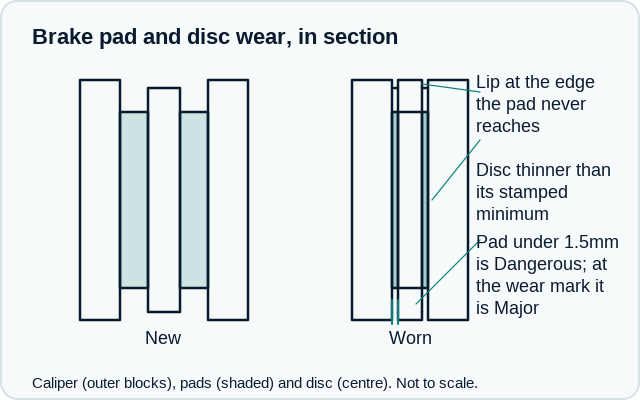
Wear and lips. Each stop takes a little metal from the disc as well as the pad. Over time the swept face thins and a raised lip forms at the outer edge where the pad does not reach.
Scoring. Grooves appear when grit gets between pad and disc, or when a pad has worn to its backing plate and metal is rubbing on metal. That second case usually comes with grinding and is far more serious.
Pitting and surface rust. Discs are bare cast iron, so they rust when a car stands, especially the rears on cars that are lightly braked, and on hybrids and electric cars where regenerative braking means the friction brakes work less. Light surface rust is normal and usually cleans off; deep pitting on the swept face does not.
A garage can measure disc thickness with a micrometer and compare it with the minimum stamped on the disc or in the manufacturer's data. That tells you how much life is left; it is not the MOT test, which is visual and asks whether wear is significant and obvious.1
What the garage does, and whether you can do it
Discs are replaced in axle pairs, almost always with new pads at the same time, because old pads have worn to the shape of the old discs. The job means removing the caliper and its carrier, taking off the old disc (sometimes held by a retaining screw, sometimes seized on with rust), cleaning the hub face so the new disc sits flat, then refitting with new pads and the correct torque settings.
Some rear discs have the handbrake drum built in, and some have the wheel bearing pressed into them, both of which add time. New discs and pads need bedding in with a few hundred miles of moderate braking.
DIY or garage? Competent home mechanics do change discs, but it is a step up from pads: seized retaining screws, a rusted hub face that makes the disc run out of true, and caliper bolts that need the right torque. A disc that is not seated flat causes judder. If you lack the tools or a torque wrench, this is one to leave to a garage.
How much do brake discs cost?
Vendors publish different things: some price discs alone, some price pads and discs together, and some don't say which axle. Read the job column carefully.
| Job | Published price | Who says so |
|---|---|---|
| Front pads and discs | £277.86 average | BookMyGarage (Nov 2026 data)4 |
| Rear pads and discs | £248.18 average | BookMyGarage (Nov 2026 data)4 |
| Front discs, per axle | £130 to £375 | Bumper5 |
| Rear discs, per axle | £125 to £350 | Bumper5 |
| Front and rear discs | £250 to £700+ | Bumper5 |
| Pair of discs | £125 to £350 | Start Rescue (2024)6 |
| Pads and discs together | £325 to £850 | Start Rescue (2024)6 |
BookMyGarage's averages come from bookings made through its site and are the most specific: the front axle ranges from £211 for a Mazda to £359.58 for a BMW in its make table.4 Start Rescue's January 2024 range for pads and discs, £325 to £850, is much higher than the booking averages; it is older and does not say whether it covers one axle.6 Bumper puts disc work on a small city car at £130 to £220 and on luxury or performance cars at £350 to £800 or more.5
Five things to ask, and why each one matters
| Ask | Why it matters |
|---|---|
| Was it written as an advisory or a fail? | An advisory is a pass. You have until the car next needs braking work, not a deadline, so there is time to get a second price. |
| What thickness did you measure, and what is the minimum? | A reading such as 22.4mm against a 22mm minimum tells you far more than "getting low", and lets a second garage compare like with like. |
| Front or rear axle? | Rear discs on a lightly braked car, or on a hybrid that brakes mostly on regeneration, often look rough from surface rust that a few firm stops clear. |
| Are new pads in the price? | They should be. Old pads have bedded to the old disc's shape and will not sit flat on a new face. |
| Did you check the calipers slide freely? | A sticking caliper wears one pad and one face far faster than the other and can ruin a new set within months. |
If you think a disc was failed when it was not significantly worn, raise it with the test centre before any repair is done. You can appeal to DVSA within 14 working days of the test.7
Reading the advisory: what to do at each stage
| What the advisory or the garage says | What it usually means | Sensible next step |
|---|---|---|
| "Corroded" or "surface rust", rear discs, car often parked | Bare iron rusting between uses; the swept face usually cleans up | A few firm stops on a quiet road, then ask for a second look at the next service |
| "Pitted" or "lipped", thickness above the minimum | Normal wear, with life left | Price pads and discs before the next service; no deadline |
| Measured below the maker's minimum, still an advisory | Not an MOT fail on its own, but less metal to soak up heat on a long descent | Replace within weeks rather than waiting for the next test |
| "Scored", with grinding when you brake | Pad worn to its backing plate, metal on metal | Drive as little as possible; this is the case most likely to end as Dangerous |
A worked example. An eight-year-old hatchback worth about £3,000 comes back with both axles advised. At BookMyGarage's booking averages, front pads and discs (£277.86) plus rear (£248.18) come to £526.04, a little under 18% of the car's value for parts that will last several years.4 That is maintenance, not a reason to sell. The sum changes when discs are one line among many on an older car: add every quote together and put the total into the repair or replace calculator. The exact advisory wording is explained in the MOT advisory checker, and the brake pads guide covers a pads-only job.
Work out your own figures
Questions people ask
Will pitted brake discs fail an MOT?
Do discs below the minimum thickness fail?
Should I replace pads with discs?
How much are front pads and discs?
Keep reading
Where these figures come from
We take every rate and rule from the official publisher and re-check it before each update. Numbers in square brackets in the text point here. Last checked 22 November 2026.
- 1DVSA MOT inspection manual, 1.1.14: brake discs and drumswww.gov.uk/guidance/mot-inspection-manual-for-private-passenger-and-light-commercial-vehicles/1-brakes
- 2DVSA MOT inspection manual, introduction: minor, major, dangerous and advisory itemswww.gov.uk/guidance/mot-inspection-manual-for-private-passenger-and-light-commercial-vehicles/introduction
- 3GOV.UK Getting an MOT: after the test, and driving a vehicle that has failedwww.gov.uk/getting-an-mot/after-the-test
- 4BookMyGarage: front and rear brake pads and discs, booking averages (data as of November 2026)bookmygarage.com/blog/brake-pads-and-discs-cost/
- 5Bumper: brake disc replacement cost guide (updated 22 July 2026)www.bumper.co/blog/brake-disc-replacement-cost
- 6Start Rescue: how much it costs to replace brake pads and discs (12 January 2024)www.startrescue.co.uk/breakdown-cover/motoring-advice/car-servicing-and-repairs/how-much-does-it-cost-to-replace-brake-pads
- 7GOV.UK Getting an MOT: appealing a result you think is wrongwww.gov.uk/getting-an-mot/problems-with-your-test-result
MotorSpend is an independent publisher, not a government service. This guide explains the rules in general terms; it is not financial, tax or legal advice for your situation. Spotted something out of date? Tell us and we will check and correct it.