The short answer
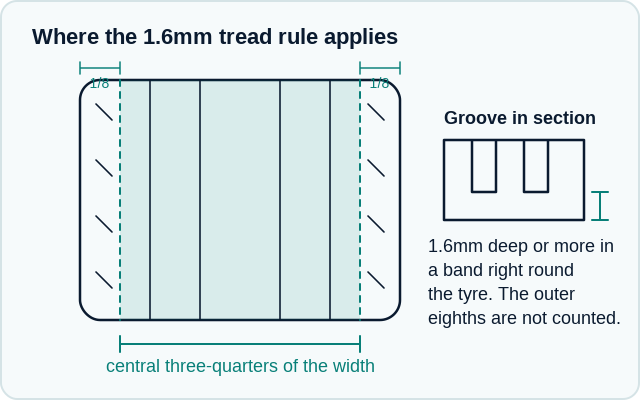
- Official MOT rule: The primary grooves must be at least 1.6mm deep within the central three-quarters of the tread, all the way round the tyre.1
- Category: An advisory passes. Tread below the limit is Dangerous, the most serious grade.1
- Can you drive? With an advisory, yes. After a Dangerous tread fail, not until the tyre is replaced.3
- Typical cost: Mid-range tyres: £70 to £80 each from Start Rescue (2024), £75 to £120 from Bumper (2026).45
What exactly does the MOT check?
Section 5.2.3 of the inspection manual sets the test for cars with up to eight passenger seats: "The primary grooves of the tread pattern must be at least 1.6mm deep within the central three-quarters of the breadth of tread and around the entire outer circumference of the tyre."1
Two details matter. First, only the primary grooves count: those containing the tread wear indicators, or cut as deep. Shallower secondary grooves and sipes are ignored. Second, the outer eighth on each side does not count, and the manual says either side of the central three-quarters "can be devoid of tread".1 A tyre worn bald on its inner edge but legal in the middle can pass, though it may still be advised.
The defect line is "Tyre tread depth not in accordance with the requirements", graded Dangerous.1 An advisory is the tester telling you the tyre is near that point, which the manual describes as an item "near to, but which have not yet reached the point of test failure".2
What else on a tyre can fail?
Tread is the common one, but the same section lists other tyre defects:1
- A cut deep enough to reach the ply or cords, beyond the size limit: Major.
- A lump, bulge or tear from structural failure, or exposed or damaged cords: Dangerous.
- Different sizes, or different structures, on the same axle: Major.
- A tyre fouling part of the car, or not fitted as the sidewall says: Major.
- A tyre obviously under-inflated: Minor.
- A tyre pressure monitoring system malfunctioning on cars first used from 1 January 2012: Major.
The tread limit in the MOT is the same as the road law. Our tyre law guide covers the roadside penalty, which is per offence and can mean points on your licence.
How long have you got after the advisory?
There is no official answer, and no tyre maker will promise a mileage, because wear depends on the car, the tyre, the road and how it is driven. What you can do is measure.
A simple way to estimate it: note the tread depth on the advisory or measure it with a cheap gauge, then measure again after a month of normal driving. If a tyre at 2.2mm loses 0.2mm in that month, it has about three months before it reaches 1.6mm. Replace it before then, not on the day.
Check all four, not just the advised one, and measure across the width: the inner edge is easy to miss and wears first when alignment is out. Most tyres have wear bars moulded into the main grooves; when the tread is flush with them, the tyre is at or near the limit.
Grip in the wet falls as tread wears, long before it becomes illegal, so many drivers replace earlier than 1.6mm. That is a judgement about safety and budget, not a legal requirement.
What a tyre fitter does, and the DIY question
A tyre fitter removes the wheel, breaks the bead, takes the old tyre off the rim, fits the new one with a new valve, inflates it and balances the wheel. Some quote balancing and valve as part of the fitted price, some separately. If the old tyre wore unevenly, ask for an alignment check, otherwise the new one will go the same way.
Pairs on the same axle are usual so grip is balanced side to side. If you replace only two tyres, many fitters suggest the newer pair goes on the rear for stability; ask yours for their policy.
DIY or garage? Fitting a tyre to a rim needs a machine and a balancer, so this is a garage job. What you can do yourself is the checking: tread depth with a gauge, pressures weekly when the tyres are cold, and a look for cuts and bulges.
What do new tyres cost?
Prices depend heavily on size and brand; a 15-inch city-car tyre and a 20-inch SUV tyre are different purchases. Published averages:
| Job | Published price | Who says so |
|---|---|---|
| Budget tyre, each | £50 to £60 | Start Rescue (2024)4 |
| Mid-range tyre, each | £70 to £80 | Start Rescue (2024)4 |
| Premium tyre, each | £200 to £220 | Start Rescue (2024)4 |
| Alignment or balancing | around £10 a tyre | Start Rescue (2024)4 |
| Budget tyre, each | £45 to £70 | Bumper (2026)5 |
| Mid-range tyre, each | £75 to £120 | Bumper (2026)5 |
| Premium tyre, each | £120 to £250+ | Bumper (2026)5 |
| Four mid-range tyres | £300 to £480 | Bumper (2026)5 |
The two sources broadly agree on budget tyres but disagree on the top end: Start Rescue puts premium at £200 to £220, Bumper at £120 to £250 or more. Start Rescue's figures date from May 2024; Bumper's from July 2026.45 Bumper also splits by car: £45 to £80 for a small city car, £100 to £180 for an SUV or crossover.5 Get a price for your exact size, which is printed on the sidewall.
Questions to ask before you buy
- What did each tyre measure? Ask for all four depths, not just the advised one.
- Is the wear even across the tread? If not, do I need an alignment check?
- Does the fitted price include a new valve, balancing and disposal of the old tyre?
- Which brand and model are you quoting, and what are the speed and load ratings? They should match the car's specification.
- Is the tyre new, or part-worn? Part-worn tyres must meet extra legal rules, covered in our tyre law guide.
- If I replace one tyre, will it match the other on that axle in size and structure? Mixing sizes or structures on one axle is an MOT failure.1
Turning an advisory into a monthly figure
Tyres are a running cost you can see coming, which makes them easy to spread. Take a car on four mid-range tyres at £97.50 each, the middle of Bumper's 2026 range, covering 10,000 miles a year on tyres that last 25,000 miles.5 That is 1.6 tyres a year, or £156 a year, about £13 a month. Open this example in the maintenance budget calculator and change the tyre price, life and mileage to match your car, then add servicing and the MOT.
Two habits stretch that figure. Swapping front and rear tyres at a service evens out wear on front-wheel-drive cars, where the fronts usually go first, and keeping pressures right stops the shoulders wearing early. Neither helps once a tyre is near 1.6mm: at that point it is a replacement, and the MOT rule above decides how long you have. Tyres are rarely the reason to give up on a car, but if they join several other items on an older car's MOT sheet, the repair or replace calculator puts the whole bill against its value. The advisory wording is decoded in the MOT advisory checker.
Work out your own figures
Questions people ask
Is a tyre close to the legal limit an MOT fail?
Why is low tread a dangerous defect rather than major?
Does the outer edge of the tyre count?
Keep reading
Where these figures come from
We take every rate and rule from the official publisher and re-check it before each update. Numbers in square brackets in the text point here. Last checked 22 November 2026.
- 1DVSA MOT inspection manual, 5.2.3: tyre condition and tread depthwww.gov.uk/guidance/mot-inspection-manual-for-private-passenger-and-light-commercial-vehicles/5-axles-wheels-tyres-and-suspension
- 2DVSA MOT inspection manual, introduction: minor, major, dangerous and advisory itemswww.gov.uk/guidance/mot-inspection-manual-for-private-passenger-and-light-commercial-vehicles/introduction
- 3GOV.UK Getting an MOT: after the test, and driving a vehicle that has failedwww.gov.uk/getting-an-mot/after-the-test
- 4Start Rescue: how much it costs to change a tyre (2 May 2024)www.startrescue.co.uk/breakdown-cover/motoring-advice/car-servicing-and-repairs/how-much-does-it-cost-to-change-a-tyre
- 5Bumper: tyre replacement cost guide by tyre type (updated 27 July 2026)www.bumper.co/blog/tyre-replacement-cost
MotorSpend is an independent publisher, not a government service. This guide explains the rules in general terms; it is not financial, tax or legal advice for your situation. Spotted something out of date? Tell us and we will check and correct it.