The short answer
- Official MOT rule: A constant velocity joint boot missing, split or insecure so that it no longer prevents dirt getting in fails.1
- Category: Split, missing or insecure: Major. Severely deteriorated but still sealing: Minor (a pass, recorded on the result).1
- Can you drive? Yes, on a split-boot Major fail, as long as last year's certificate is still running and the car is roadworthy; a Dangerous joint must be fixed first.3
- Typical cost: CV boot only: £50 to £140. CV joint: £250 to £900 (both from Bumper).4
What the MOT manual says about CV boots
CV boots are tested under section 6.1.7, transmission, in the inspection manual. The tester inspects drive shafts, prop shafts, their couplings and bearings. The two boot lines are:1
- "A transmission shaft constant velocity joint boot severely deteriorated": Minor.
- "A transmission shaft constant velocity joint boot missing, split or insecure so that it no longer prevents the ingress of dirt": Major.
The same section also fails the joint itself: "A transmission joint, belt or chain excessively worn" is Major, and "A transmission so worn it is likely to fail" is Dangerous.1 So a split boot fails as Major, but if the joint behind it has been ruined by dirt the car can fail on the joint as well.
An advisory such as "CV boot deteriorated" sits below the Minor line: the tester saw cracks or perished rubber and wrote them down so you know before they split.2
Why a split boot matters
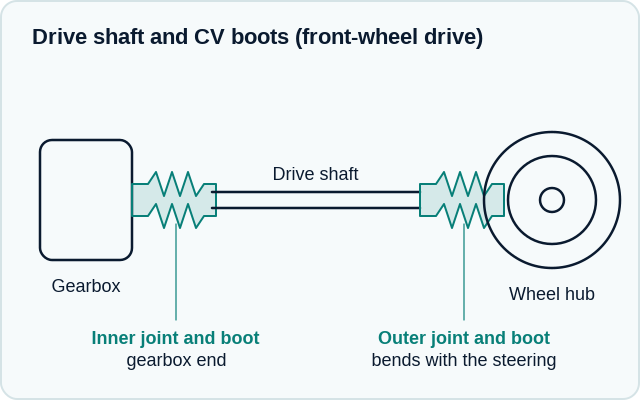
A front-wheel-drive car has constant velocity joints at each end of each front drive shaft, letting the wheels turn and move up and down while still being driven. Each joint is packed with grease and sealed by a flexible rubber or plastic boot, held on with clips.
Boots perish with age and heat, and can be torn by road debris. Once split, the joint spins grease out (often visible as a spray of black grease inside the wheel arch) and lets water and grit in. Grit grinds the joint's internals and it starts to wear. A worn outer joint typically clicks on full lock when pulling away; that symptom tells you to get it looked at, not that the joint is definitely finished.
Timing is everything with this repair. A boot replaced while the joint is still clean is a small job. A joint that has run dry or full of grit needs replacing, which is what makes the cost jump.
What the garage does, and whether it is a DIY job
There are three ways a garage might fix it:
- New boot kit: the drive shaft is removed or disconnected, the joint taken off, cleaned, inspected, repacked with fresh grease, and a new boot fitted with new clips. This is the right answer if the joint is still good.
- New joint: if the joint is worn, a replacement joint usually comes with its own boot and grease.
- New drive shaft: on some cars a complete shaft costs little more than a joint and saves labour.
Some garages offer "split" or universal boots that fit without removing the joint. They are quicker, but ask how long they are expected to last.
DIY or garage? A boot change is a classic home job for someone comfortable with removing a hub nut that is very tight, separating a ball joint and handling a messy, heavy drive shaft. Most owners pay a garage; it is a modest labour job if the joint is sound.
How much does a CV boot cost to replace?
We could verify only one vendor publishing CV prices, so this table is short and you should treat it as a guide rather than a market range:
| Job | Published price | Who says so |
|---|---|---|
| CV boot only | £50 to £140 | Bumper4 |
| CV joint replacement | £250 to £900 | Bumper4 |
Bumper describes the boot-only job as "a common MOT failure" and says the joint figure depends on make and model, adding that in some cases the whole drive shaft needs replacing rather than just the joint.4 Most of a boot bill is labour, so your local hourly rate matters; our labour rates guide shows the published spread from £47 to £141 an hour.
Why acting early pays: on Bumper's figures the most expensive boot job, £140, is still under the cheapest joint job, £250. The gap is the cost of letting dirt into the joint.
What to ask before the car goes up on the ramp
| Ask | What the answer tells you |
|---|---|
| Inner or outer boot, and which side? | Outer boots split more often because they flex with the steering. An inner boot can mean the drive shaft has to come out. |
| Is the joint still quiet and tight? | A clicking noise on full lock means grit has already done damage, and the job moves from a boot to a joint. |
| Boot kit, joint or a complete shaft? | A complete exchange shaft can cost little more than a joint once labour is counted. Ask why they chose that option. |
| One-piece boot or a split, fit-without-removal type? | Split boots are quicker to fit but rely on a glued or clipped seam. Ask what warranty the garage gives on each. |
| Will you look at the other side while it is in? | Boots of the same age tend to go together, and the wheel is already off. |
| Will you call me if the joint turns out to be worn? | That stops a £50 to £140 boot job growing into a joint bill without your agreement. |
What the garage tells you about the job, and that you rely on when you agree to it, forms part of the contract under the Consumer Rights Act.5
The cost of waiting: a boot now or a joint later
A torn boot does not stop the car working, which is why it is tempting to leave. The figures say otherwise. On Bumper's published ranges the dearest boot-only job, £140, still costs £110 less than the cheapest joint replacement, £250, and the gap to the top of the joint range, £900, is £760.4 Every week of driving with a split boot flings out grease and lets in road grit, and the joint is what that grit wears.
Put another way: if waiting gave even a one-in-five chance of turning a £95 boot job (the middle of Bumper's range) into a £575 joint (the middle of its joint range), the expected cost of waiting would be about £96 more than fixing it now, before counting a second MOT visit. The one-in-five is our illustration, not a measured rate, but the shape of the sum holds for almost any odds you pick.
So a split boot on its own is a fix-now job, not a reason to give up on the car. If it shares an MOT sheet with several other failures on an older car, total the quotes and test them in the repair or replace calculator. The advisory wording is decoded in the MOT advisory checker. Clunks from the front end are not always CV joints; worn bushes are the other usual suspect, covered in the suspension bush guide.
Work out your own figures
Questions people ask
Is a split CV boot an MOT fail?
Is a perished CV boot an MOT fail?
How much is a CV boot replacement?
How much is a CV joint?
Keep reading
Where these figures come from
We take every rate and rule from the official publisher and re-check it before each update. Numbers in square brackets in the text point here. Last checked 22 November 2026.
- 1DVSA MOT inspection manual, 6.1.7: transmission shafts and constant velocity joint bootswww.gov.uk/guidance/mot-inspection-manual-for-private-passenger-and-light-commercial-vehicles/6-body-structure-and-attachments
- 2DVSA MOT inspection manual, introduction: minor, major, dangerous and advisory itemswww.gov.uk/guidance/mot-inspection-manual-for-private-passenger-and-light-commercial-vehicles/introduction
- 3GOV.UK Getting an MOT: after the test, and driving a vehicle that has failedwww.gov.uk/getting-an-mot/after-the-test
- 4Bumper: CV joint and CV boot repair costs (27 October 2026)www.bumper.co/blog/cv-joint-repair-cost
- 5legislation.gov.uk: Consumer Rights Act 2015, section 50 (what the trader says is binding)www.legislation.gov.uk/ukpga/2015/15/section/50
MotorSpend is an independent publisher, not a government service. This guide explains the rules in general terms; it is not financial, tax or legal advice for your situation. Spotted something out of date? Tell us and we will check and correct it.